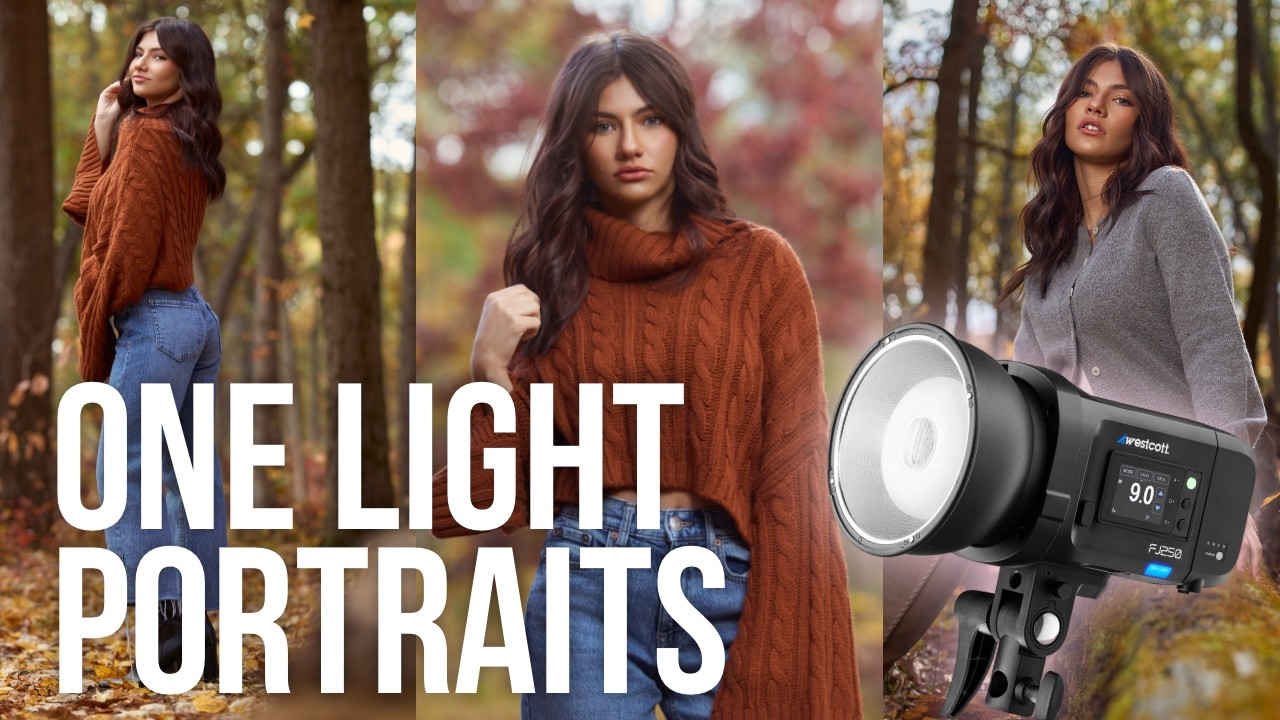
I’ve spent enough time on location shoots to know that less gear doesn’t mean less control—it means smarter control. In this excellent tutorial, Joel Grimes presents portrait photographer Eli Infante demonstrating exactly how to leverage a single portable strobe to create multiple portrait looks that rival studio-quality results. The setup? A Westcott FJ250, a beauty dish, and a painter’s pole. No assistants required. No elaborate light stands. Just methodology.
I’m going to break down what makes this approach work, expand on the techniques shown, and give you my honest assessment of when and why this portable system outperforms larger alternatives.
The Portable Strobe Advantage: Why This Matters
Before we get into settings and placement, understand why this matters. Traditional outdoor portraiture either surrenders to available light or requires a crew. The beauty dish and portable strobe eliminate that false choice. You get the light modifier’s quality and control while maintaining mobility that a 5-foot beauty dish on a heavy stand simply cannot offer.
The FJ250 is rated at 250Ws, which is adequate—not excessive. This is intentional. Lower power means faster recycling times, less battery drain, and positioning flexibility. You’re not overpowering the sun here; you’re orchestrating it.
Technique 1: Sun as Rim Light (Cross-Lighting Strategy)
One of the most elegant techniques Eli demonstrates is positioning your strobe opposite the sun direction. This creates what I call “dimensionality through opposition.”
Here’s how it works in practice:
Step 1: Position the sun behind or to the side of your subject. You want rim light naturally. The sun becomes your backlight and edge definition tool.
Step 2: Place your strobe on the opposite side at roughly 45 degrees. The painter’s pole adapter keeps it high and out of frame while remaining mobile enough that you can adjust between shots.
Step 3: Expose for the fill light, not the sun. This is critical. Your shutter speed and aperture choices prioritize the strobe output, allowing the sun to enhance rather than blow out.
The result? A three-dimensional portrait with natural separation from the background. The rim light does the heavy lifting on perceived depth, while your strobe defines the face.
I’ve tested this against traditional reflector techniques, and the strobe wins every time because of its consistency. Reflectors are subject to angle, diffusion quality, and changing sun position. A strobe is a constant.
Technique 2: Natural Light vs. Off-Camera Flash Comparison
Eli’s side-by-side comparison in the video is worth watching frame-by-frame. Without the strobe, outdoor light—even on overcast days—can feel flat. With the strobe, there’s immediate “pop.” The catch-light in the eyes becomes pronounced. Skin texture gains modeling rather than looking washed.
But here’s my strong opinion: that “pop” should feel natural. A common mistake is over-powering your strobe relative to ambient light. The goal isn’t a flash-obvious look; it’s augmentation.
My formula: Your strobe should output roughly equal to or slightly less than the ambient fill reaching your subject’s face. This maintains the outdoor quality while adding punch. Measure this by looking at your histogram post-capture—you want detail throughout, not crushed shadows or blown highlights in the strobe-lit areas.
Camera Settings for High-Speed Sync (HSS)
This is where portable strobes shine, and it’s where many photographers get confused.
Understanding Your Baseline
Eli shoots apertures between f/2.0 and f/2.8. This is shallow enough for subject isolation but deep enough to maintain eye sharpness. Shutter speed varies depending on whether you’re using HSS or not.
When You’re NOT Using HSS
Your camera’s native sync speed (typically 1/200th or 1/250th) is your ceiling. At this speed, you can expose for ambient and balance your strobe as fill. This works beautifully on overcast days or during golden hour when ambient light isn’t overpowering.
Settings example: f/2.8, 1/200th, ISO 100. Your strobe outputs around 50-75% power at 6-8 feet distance.
When You ARE Using HSS
This is where you reclaim your creative control in bright sunlight. HSS allows shutter speeds up to 1/4000th or faster, meaning you can shoot wider apertures in direct sun.
The trade-off: HSS requires more strobe power and drains batteries faster. But it’s non-negotiable for that f/2.0 look in midday sun.
Settings example: f/2.0, 1/2000th, ISO 100. Your strobe now runs at 75-100% power, closer to the subject (5-6 feet) to maintain output.
Here’s my practical advice: start at your sync speed and work upward. Only push into HSS if you need that shallow depth of field or if ambient is simply too bright to manage.
Light Placement Secrets: Distance and Modifier Size
The distance between your beauty dish and subject determines light quality and falloff. Move closer (4-5 feet), and the light becomes larger relative to the subject, creating softer transitions. Move farther (8-10 feet), and you increase contrast and directional punch.
For portraits, I prefer 6-7 feet as a starting point. This gives you the beauty dish’s soft quality without so much diffusion that you lose modeling. The painter’s pole keeps this distance consistent while allowing vertical and horizontal adjustments.
The beauty dish itself is the right choice here. Larger than a reflector, smaller than a 5-foot octabox, it’s the Goldilocks modifier for location work. It throws light efficiently (better reach than a softbox) while maintaining character. I’ve seen Eli pull this off with success because the tool matches the environment.
Composition: Why Light Placement Serves Design
One detail I appreciated in the tutorial was how Eli uses compositional elements—logs as leading lines, trees as framing. Your strobe placement should reinforce composition, not fight it. Position your strobe to light the subject in a way that reveals the environment naturally.
This is where the portable approach wins. You can quickly move to positions that would be impossible with heavy stands. You’re thinking like a documentarian while maintaining studio control.
Watch the Full Tutorial
The techniques here are foundational, but watching Eli execute them in real time shows nuances that words cannot capture. The exact angle adjustments, the refinement of strobe power between shots, the way he uses the painter’s pole—these require visual learning.
Watch the full tutorial on YouTube to see this system in action across multiple scenarios.
This approach changed how I think about location portraiture. You don’t need less gear to be mobile; you need the right gear. The FJ250, beauty dish, and painter’s pole prove that constraint breeds creativity.