I had a client last month who wanted “edgy” headshots. Motorcycle guy, leather jacket, the whole thing. My instinct was to reach for my usual two-light setup, add a rim light, keep things controlled. The results were technically fine and completely soulless. Everything was visible, which meant nothing was interesting. The image had no tension.
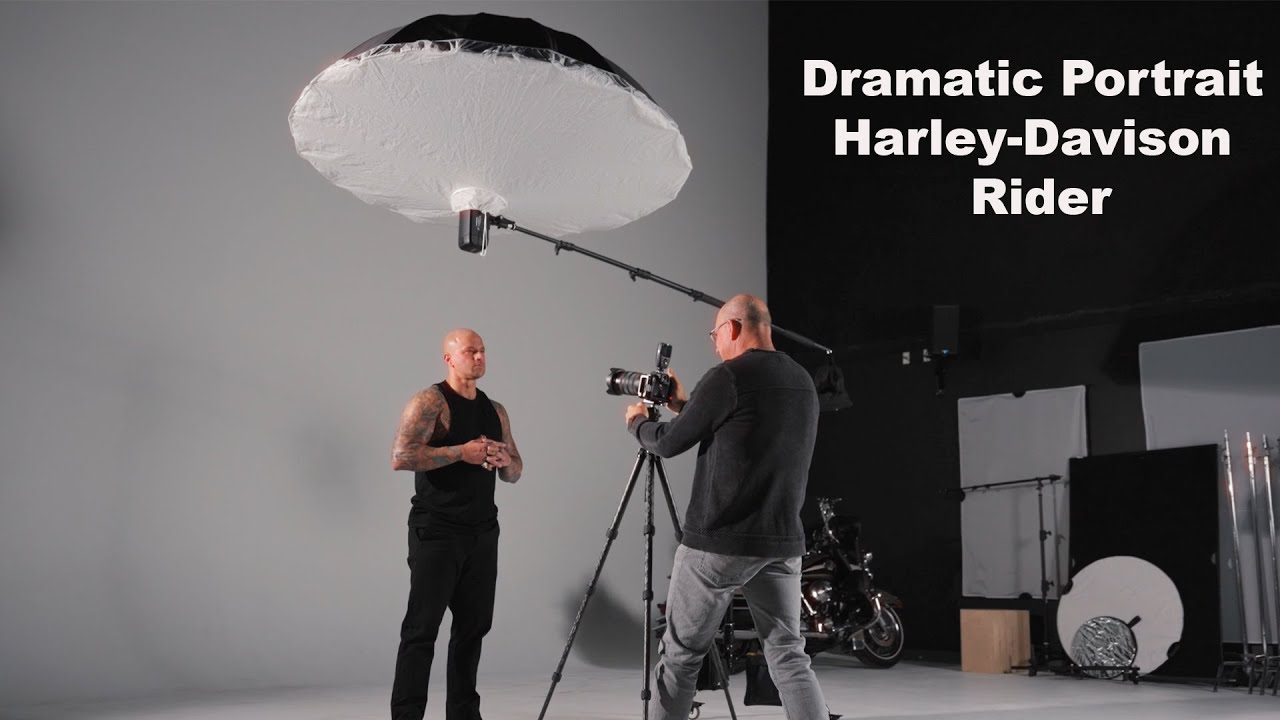
That failure sent me back to a tutorial I’d bookmarked and never properly sat with. In this Joel Grimes behind-the-scenes video, filmed at Westcott’s Ohio headquarters, he builds a genuinely dramatic single-light portrait of a Harley-Davidson rider using nothing but a 7-foot umbrella, a front diffusion panel, and an FJ400 strobe. The setup sounds almost too simple. The results are not.
Why a 7-Foot Umbrella Changes the Math on Shadow
Most photographers think big modifiers mean soft, flat, even light. And they’re right, if you center the light on your subject and work close. Grimes does something different. He uses the sheer size of the 7-foot umbrella not to eliminate shadows but to shape where they fall and how gradually they transition.
The modifier here is the Westcott 7-foot white/black umbrella with the front diffusion panel attached. The white interior reflects and softens. The black backing keeps light from spilling behind the modifier and contaminating the background. The diffusion panel on the front takes that already-softened light and smooths it further, reducing any hot spot from the strobe head. What you end up with is a source that’s large enough to wrap around a face but still directional enough to let the shadow side go genuinely dark.
Size matters, but placement matters more. A 7-foot umbrella positioned directly in front of a subject will fill everything. Moved to the side and angled correctly, that same modifier becomes a tool for contrast.
The Exact Position and Power Settings
Grimes runs the FJ400 strobe at a relatively low power setting, which gives him the fast recycle time and color consistency he needs while keeping the light output manageable indoors without a lot of ambient to fight. He positions the umbrella to the side of the subject, roughly 45 degrees off axis, and slightly above eye level, angled down. Classic Rembrandt territory in terms of geometry.
The key detail is how close he brings the light. Large modifiers are often kept at a comfortable working distance, but Grimes brings the 7-footer in close to the subject. Close placement makes the light source appear larger relative to the subject’s face, which softens the transition from highlight to shadow. It also means the light falls off quickly. A few feet of distance change and the shadow side drops significantly.
He is not trying to achieve even illumination across the face. He wants the lit side to be fully exposed and the shadow side to fall toward black. The ratio here is steep, easily 4:1 or beyond. There is no fill card, no reflector, no second light. What the umbrella does not reach, stays dark. That choice is the whole technique.
Reading the Histogram Instead of the LCD
One thing Grimes emphasizes that I have started doing more deliberately: he meters and reads his histogram rather than trusting the LCD preview. On a bright studio monitor the image can look correctly exposed when it is actually underexposed. He exposes for the highlights on the lit side of the face, letting them sit just below clipping, and accepts that the shadow side will be deep. The histogram confirms that the bright values are where he wants them. Everything else follows from that decision.
I keep a lighting journal where I sketch every setup from every shoot, mostly because I got burned early in my career by not writing things down and spending an hour trying to recreate a look I knew I had nailed before. Looking back at my Rembrandt setups from the last two years, the exposures that worked best all share this same histogram shape: a cluster of midtones and highlights on the right, and shadow values that simply run off the left edge of the chart.
Where I Would Push This Further
The Grimes setup works beautifully for a certain kind of subject. Strong features, defined bone structure, confidence in front of the camera. The dramatic shadow serves the Harley rider because it matches the identity of the image.
Where I would adapt this: for clients with softer features or rounder faces, that steep ratio can feel unflattering rather than cinematic. My workaround is to keep the same single-light geometry but add a white V-flat about six feet off the shadow side of the subject, not to fill aggressively, but to put a faint ambient bounce into the dark side. It takes the ratio from 4:1 down to maybe 3:1. The image still reads as dramatic, but the shadow side retains just enough detail to feel intentional rather than accidental. The single-light philosophy stays intact. You are not adding a second light source; you are managing what the room is already doing.
The Modifier Does Not Make the Image, the Placement Does
After sitting with this tutorial carefully and running my own tests with the Westcott 7-foot umbrella and FJ400, the thing I keep coming back to is this: the gear Grimes uses is genuinely excellent, but the result comes from the deliberate decision to position that gear for shadow, not for coverage. Most photographers, myself included, default to solving for exposure across the whole frame. Grimes solves for the highlight and lets the rest be what it will be.
That single shift in thinking is worth more than any new modifier you can buy.
Watch the full video to see how Grimes works with his subject in real time and how subtle adjustments to the umbrella position change the image on every frame: Joel Grimes - Dramatic Portrait With One Light. The visual demonstration of his positioning decisions is something a written breakdown cannot fully replace.
Comments (3)
Just subscribed. If the rest of your content is this good, I'm in.
Just used this on a wedding shoot edit. Client was thrilled.
Really solid breakdown. This pairs perfectly with the color grading work I've been writing about.
Leave a Comment