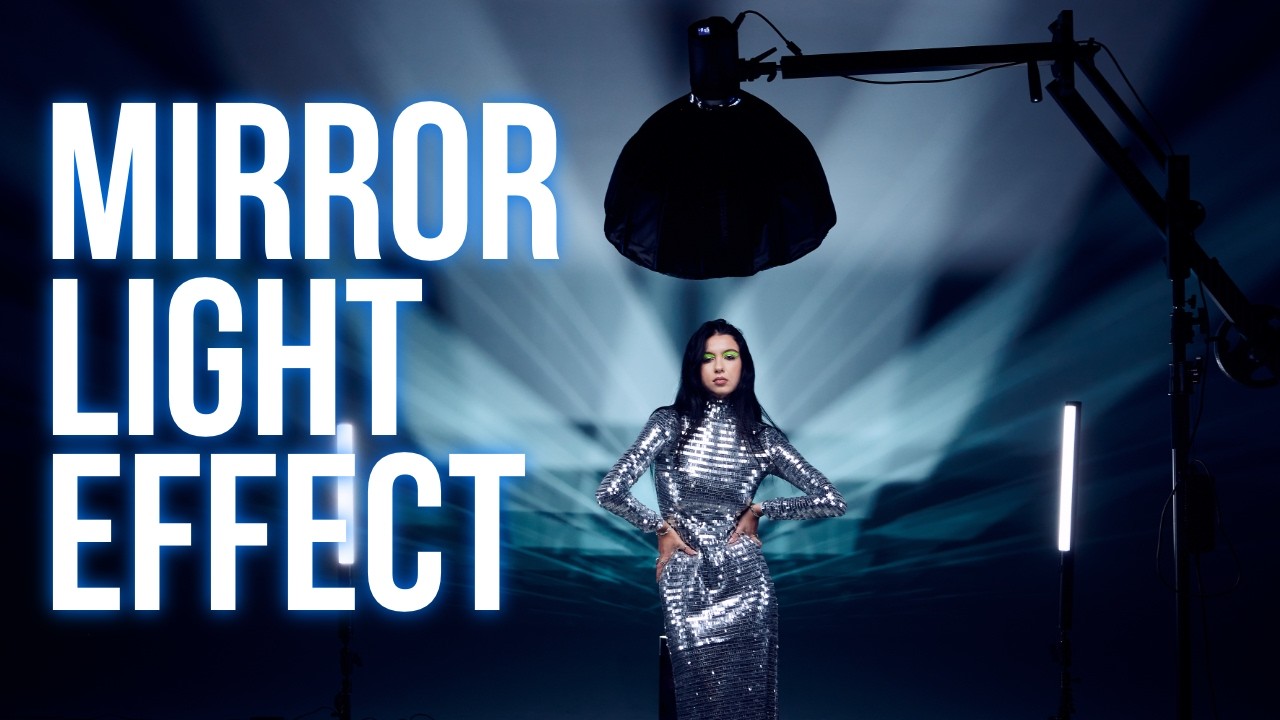
I’ve been following Joel Grimes’ work for years, and his recent tutorial with Ashley Boring on creating mirrored lighting effects caught my attention for one specific reason: it proves that gear specifications matter far less than understanding why you’re using them. In this excellent tutorial, Joel Grimes walks through a lighting concept that nearly worked five years ago but failed to deliver the sharpness required. By making one critical switch—from flash to constant LED—the entire technique finally clicked into place.
This isn’t just another lighting hack. This is about understanding light source geometry and how it directly impacts your final image.
The Problem With Flash for Geometric Effects
Before we build anything, let’s talk about why this technique initially failed. When Ashley originally tested this mirrored effect, she was using a traditional strobe—specifically, the kind of flash tube you find in most studio strobes. Flash tubes are elongated, linear light sources. While they’re excellent for punch and recycle time, they create a diffuse, slightly soft reflection when passed through a prism or mirror array.
For geometric lighting patterns—especially ones that demand crisp triangles and defined edges—you need something different entirely. The geometry of your light source becomes the template for everything that follows.
Here’s my take: too many photographers blame their lighting modifiers when the real culprit is the shape of the light source itself. You can’t create a sharp geometric pattern with a soft, linear light source no matter how good your modifier is.
Building Your DIY Mirror Prism
The construction is refreshingly simple, which is why I appreciate this tutorial so much. You don’t need expensive optical equipment.
What You’ll Need:
- Mirrors (small, flat mirrors work best)
- Gaff tape (professional-grade, not duct tape—there’s a difference)
- A steady hand
- About 30 minutes
The Assembly Process: Start by arranging your mirrors into a prism shape. The angle you choose here directly affects the final pattern. Ashley demonstrates the assembly clearly in the video, but the key principle is this: the mirrors must sit at precise angles relative to each other. Any gap or misalignment will break your geometric pattern.
Use gaff tape to secure the mirrors together. I’d recommend taping along the edges where mirrors meet, creating a rigid structure. You want zero flex once it’s assembled—movement during your shoot will compromise sharpness.
The size of your prism matters. Smaller prisms create tighter, more defined patterns. Larger ones spread the light more, which can be useful for different effects but requires more precision to maintain sharpness.
Why Constant Light Changes Everything
This is the critical insight from the tutorial. Ashley switched from the FJ400 II Strobe to the L120-B LED, and the difference was immediate and measurable.
The L120-B’s advantage isn’t raw power—strobes win there. The advantage is the COB (chip-on-board) LED’s compact, concentrated light source. A COB LED approximates a point source of light much more effectively than a flash tube ever could. When that concentrated light bounces off your mirror prism, it creates clean, razor-sharp reflections with minimal diffusion.
This is where most tutorials go wrong. They show you how to build something but don’t explain why certain gear works. In this case, the shape of the light source is the foundation of the entire technique.
Here’s my personal stance: if you’re pursuing geometric or patterned lighting effects, constant LED light with a small COB chip should be your first choice. Yes, you’ll sacrifice some of the instant power and recycle speed of a strobe. But you gain precision, and precision is non-negotiable for work like this.
Subject Placement and Light Spread
Video production often glosses over setup details, but this tutorial gets into the specifics of positioning.
The distance between your prism, your light source, and your subject dramatically affects how the pattern reads. Too close, and the light spread becomes uneven. Too far, and you lose the definition that makes this technique work in the first place.
Ashley walks through the troubleshooting process—adjusting subject position to find where the pattern sits most cleanly. This is exactly the kind of methodical approach I respect. Lighting isn’t magic; it’s geometry and physics. When something isn’t working, there’s always a reason, and it’s usually about distance or angle.
Start with your light about 3-4 feet from the prism, and your subject about 2-3 feet beyond that. Adjust from there based on how the pattern appears on your subject. Watch the side-by-side comparison in the full video—you’ll see exactly how tweaks in positioning change the final pattern.
The Takeaway: Match Your Tool to Your Technique
After watching this tutorial, the lesson is clear: lighting techniques aren’t universal. The tool you choose must match the effect you’re after. If you want sharp geometric patterns, you need a point-source light. If you’re building a DIY modifier, you need to understand the constraints of your light source before you even tape the first mirror together.
This is why I always encourage photographers to think about light source geometry before purchasing gear. A $400 LED with the right chip will outperform a $2000 strobe for certain applications.
Watch the full tutorial to see Ashley walk through the entire process step-by-step, complete with real-time adjustments and the direct comparison between strobe and LED performance. The 15-minute investment will save you hours of frustration on your next geometric lighting shoot.