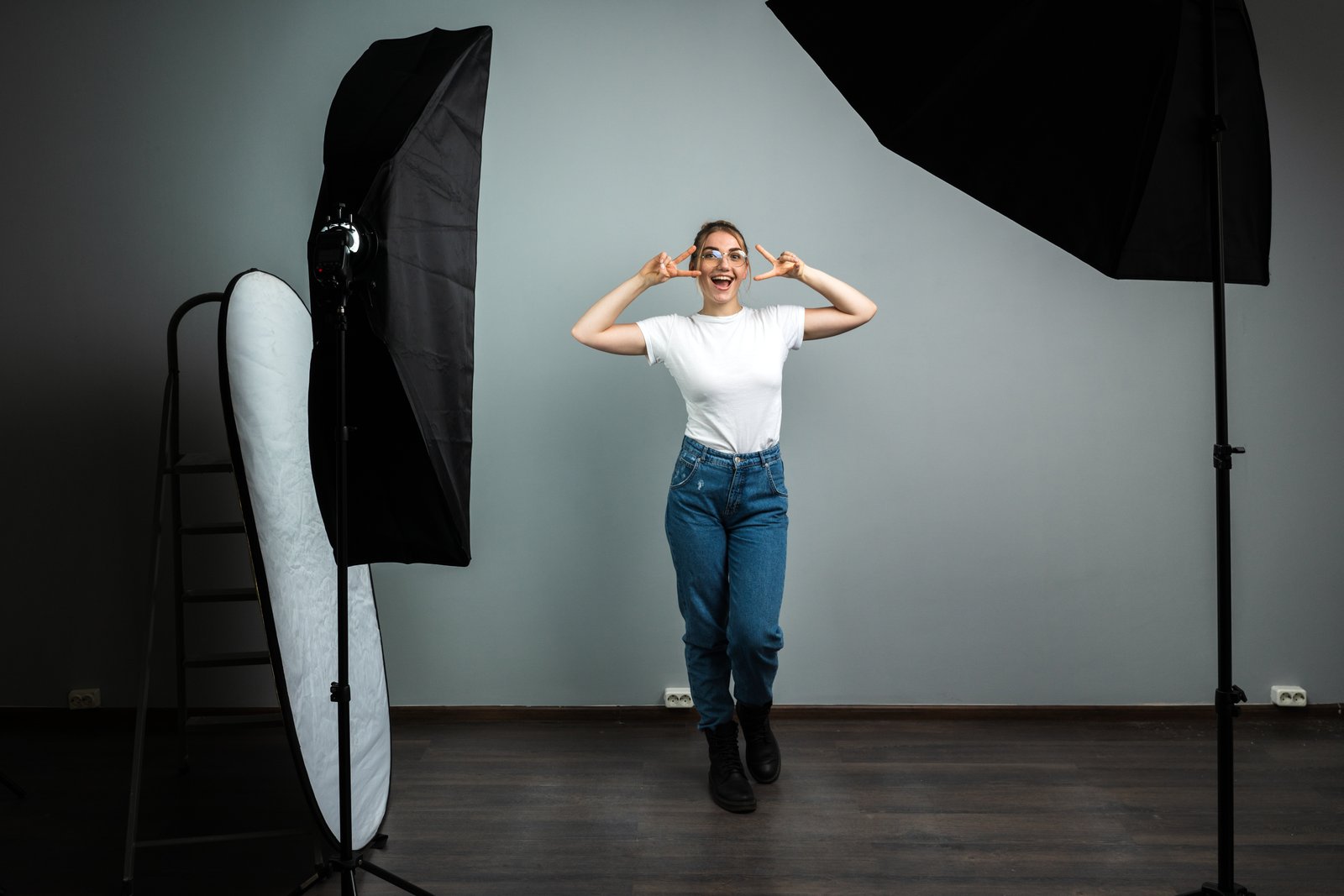
Every modifier in my studio has a strip of masking tape on it with a label. Not a cute nickname. A descriptor: “36-inch octa,” “5-degree grid,” “48x36 strip.” I started doing this years ago because I got tired of grabbing the wrong tool in the middle of a tethered shoot while a client sat behind my monitor. The labeling habit sounds obsessive until the day it saves you from making a $4,000-an-hour mistake.
The point is: light modifiers are not interchangeable. A lot of photographers treat them like they are, swapping between a softbox and an umbrella because they both “soften the light.” They don’t do the same thing. Not even close. Understanding why is the difference between intentional lighting and hoping for the best.
The Physics Nobody Explains in Plain English
Light behaves according to a few principles that don’t care about your creative vision. The most important one for modifiers is this: the larger the light source relative to your subject, the softer the light. More precisely, the softer the transitions between highlight and shadow.
But size is only half of it. The other variable is the quality of the diffusion, which is determined by how the modifier shapes and controls the light before it hits your subject. A 60-inch parabolic umbrella is enormous, but it throws light everywhere. A 60-inch octabox with a front baffle contains the same spread, concentrates the output, and gives you a much more controlled specular highlight in the eye. Same size. Completely different result.
Feathering matters too. Most photographers aim the center of their modifier directly at the subject. I almost never do. The edge of a softbox is softer than the hot center, and pointing the edge toward your subject’s face rather than the core can take a harsh modifier and make it behave like something twice its size. This costs nothing. It just requires understanding what you’re working with.
Softboxes, Octaboxes, and Strip Lights Are Not the Same Tool
I run a Profoto D2 as my main unit, and I rotate through four modifiers depending on the job.
For full-length fashion, I use a 4x6 foot Profoto Giant Softbox with both internal and front baffles in place. At f/8, ISO 100, that unit at six feet from my subject gives me beautiful, even coverage from head to toe with wrap that reads well on video too, since a lot of my clients want stills and content from the same session.
For beauty and close-up work, I switch to a 24-inch Profoto Octa RFi. The smaller source creates more defined shadows, which means more visible bone structure. I place it roughly 18 inches from the subject’s face and usually add a 40-degree grid to kill spill on the backdrop.
Strip lights, which are typically 12x36 or 12x48 inches, are for creating edge definition. I use a pair of Godox SB-FW-35120 strips (around $90 each) as side kickers on commercial product work and on bodies when I want to carve out shape on a dark background. They’re not glamorous, but they do something no other modifier does as efficiently.
The mistake I see constantly is photographers using an octabox for everything because it creates a beautiful catchlight. It does. But it also softens everything equally, which means you lose the ability to sculpt. Beauty and editorial work usually require different tools within the same shoot.
Grids: The Modifier Most Photographers Skip
A grid is a fabric or metal honeycomb that attaches to the front of your softbox or octa and narrows the angle of light output. A 40-degree grid limits your spread noticeably. A 20-degree grid is surgical.
I use grids on probably 70 percent of my shoots. Without one, light from your modifier bounces off every white wall and reflective surface in your studio and wraps back into your shadow areas. That sounds soft and nice until you’re trying to create contrast and you can’t because ambient fill is eating your ratio.
With a 40-degree grid on my key light and no fill at all, I can shoot at a 3:1 ratio in my white studio without fighting the walls. Without it, that same setup collapses to something closer to 1.5:1 because of all the bounce. Grids are not optional equipment. They’re how you maintain control over your own space.
When I Got Modifiers Wrong on a Real Job
Early in my career I photographed a beauty editorial for a regional magazine using a large parabolic umbrella as my key. I loved the look of it in tests. The spread was massive, the catchlights were gorgeous, and the light had this quality I couldn’t fully describe at the time.
On set, I couldn’t control it. The umbrella was throwing light into my background, contaminating my shadow side, and making my backdrop go at least a stop brighter than I wanted. I spent two hours fighting a setup I should have seen coming. The shots were usable, barely, but I kept one of my lighting journal sketches from that day specifically as a reminder. The modifier wasn’t wrong. I was using it wrong, in the wrong environment, without understanding the physics behind what it was actually doing.
That job is the reason I now test every new modifier the day it arrives, in my own studio, before it ever appears on a paid shoot.
Parabolic Reflectors and Where They Actually Belong
Parabolic reflectors, the deep silver-lined dishes that focus light to a near-point source, are often marketed as a one-modifier solution. They’re not. A deep parabolic like the Broncolor Para 88 (roughly $2,000 new) creates a focused, specular light that reads almost like sunlight. It’s extraordinary for high-contrast editorial and for replicating natural window light with hard falloff.
It is not a substitute for a softbox in commercial work where a client needs clean, even coverage on a product or a face that will be retouched extensively. The wrong modifier for the context makes more work in post, and post is where budgets go to die.
Know what each tool does before you label it a favorite. The modifier that solves every problem usually solves none of them particularly well.
Comments (3)
Clear and practical. No fluff. Appreciate that.
Quality content like this is rare. Keep it up.
Couldn't agree more. I've seen this make a huge difference in workflows work specifically.
Leave a Comment