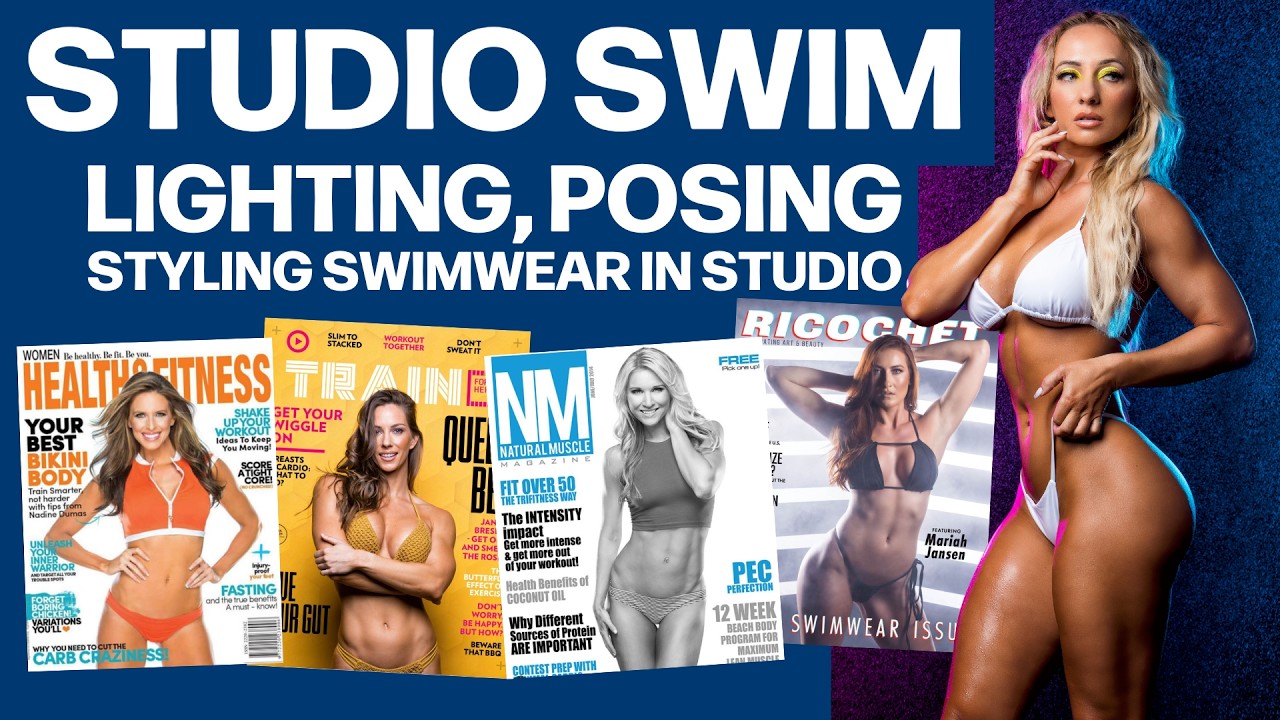
Last month I got a booking from a small activewear brand that had pivoted into swimwear. They needed catalog shots, clean white-background stuff, and a handful of editorial-leaning images for their website hero. I’ve shot plenty of fitness and apparel work, but swimwear has its own specific gravity. The lighting that flatters a jacket flatters almost nothing else. The posing that reads confident in sportswear can read uncomfortable or overly exposed in a swimsuit. I spent an evening before the shoot rewatching one tutorial I’d bookmarked months earlier and never fully processed.
Watch the full tutorial on YouTube
In this CreativeLive workshop, James Patrick walks through an entire studio swimwear shoot from setup to delivery. It’s one of the more practical photography tutorials I’ve come across because Patrick doesn’t abstract the process. He shows the math: light placement, modifier choice, power ratios, posing direction, even how to move a model through suit changes without losing momentum. Here’s what I took from it and how I applied it.
Why Swimwear Lighting Is Its Own Problem
Most photographers understand that soft light is flattering. What they underestimate is how much fabric color, skin tone, and surface texture interact with each other in swimwear specifically. A broad softbox that renders a model’s face beautifully can wash out the texture in a patterned suit and leave the skin looking two-dimensional. Patrick addresses this directly. He works with a large octabank as his key, positioned close and slightly above eye level, which gives him the wrap-around softness that flatters skin. But he pairs it with a reflector below the frame rather than a fill light. That single choice keeps the light from going completely flat. The reflector bounces enough light back into the shadows under the chin and collarbone without adding a second catchlight or muddying the direction of the light. The ratio he’s working with is roughly 3:1, key to fill. Not dramatic, not flat.
He also keeps a hair light in play, positioned high and behind the subject, flagged tightly so it skims the shoulders and the edge of the suit without spilling onto the backdrop. That edge separation is doing a lot of work. It keeps the subject from dissolving into the background and adds a three-dimensional quality that the key light alone can’t produce.
Posing That Reads as Confident, Not Exposed
This is where Patrick spends a significant portion of the workshop, and rightfully so. Swimwear posing fails in one of two ways: the model looks stiff and self-conscious, or the pose draws attention to exposure rather than redirecting it. His approach starts with weight. He consistently directs models to shift weight onto their back leg, which tilts the hip slightly and creates a natural S-curve without requiring an exaggerated or uncomfortable position.
From there, he works from the ground up. Foot placement first, then hip, then torso rotation, then arm position. He talks about arms being a constant problem in swimwear. Arms hanging straight at the sides create a rigid silhouette and also widen the body visually. His fix is simple: give the arms something to do. A hand lightly on the hip, fingers trailing down the thigh, one arm extended slightly forward. He directs models to think about reaching rather than posing, which produces a much more natural extension in the arms and shoulders.
He also talks about chin position as a trust indicator. When a model drops their chin too far, it can read as uncertainty or discomfort. A slight chin lift, even just a few degrees, changes the entire energy of the frame.
Creating Wet-Look and Water Effects Without a Pool
This section is genuinely useful for anyone who’s been asked to produce beach-adjacent imagery in a landlocked studio. Patrick uses a combination of techniques to get a wet-look result. A fine mist sprayer on the skin creates surface sheen. He controls the amount carefully, because too much mist reads as sweat rather than water. The key is a light, even application that catches the highlight from the hair light and creates small bright specular points on the skin.
For the suit itself, he applies a slightly heavier spray, enough to darken the fabric and make it appear wet without making it transparent. He checks this in the camera before committing, because some fabrics react differently. The other element he uses is a thin layer of baby oil on the legs and arms, blended out, which increases the reflectivity of the skin and gives it a luminous quality that reads as sun-lit even under studio conditions. Glycerin works similarly if you want a slightly heavier result. The combination of mist plus oil plus a well-placed edge light produces a convincing water-effect image without a single drop of real water anywhere near the equipment.
Where I’d Push Back Slightly
Patrick’s lighting setup is clean and replicable, which is exactly what you want for e-commerce catalog work. But for editorial swim, I’ve found that introducing a second hard light source at a low angle can add drama that the single octabank setup doesn’t reach. I keep a gridded strobe at about waist height off to one side, set roughly two stops below the key, which produces a raking light across the torso. It picks up muscle definition and suit texture in a way that reads more editorial than catalog. It’s not always appropriate, and it requires more precise posing because it punishes awkward angles. But for a brand that wants an aspirational, magazine-style look rather than clean e-commerce delivery, that lower raking light is worth experimenting with.
The Single Thing That Changes Everything
The posing and the lighting both matter, but they only work when the model trusts the photographer’s direction enough to commit to the pose fully. Patrick earns that trust early by being specific. Vague direction produces uncertain models. Specific direction, foot here, chin there, reach this way, produces confident images.
Watch the full tutorial on CreativeLive’s YouTube channel for the visual demonstration. The lighting diagrams and the live shoot footage are the parts that don’t fully translate to text.
Comments
Leave a Comment